

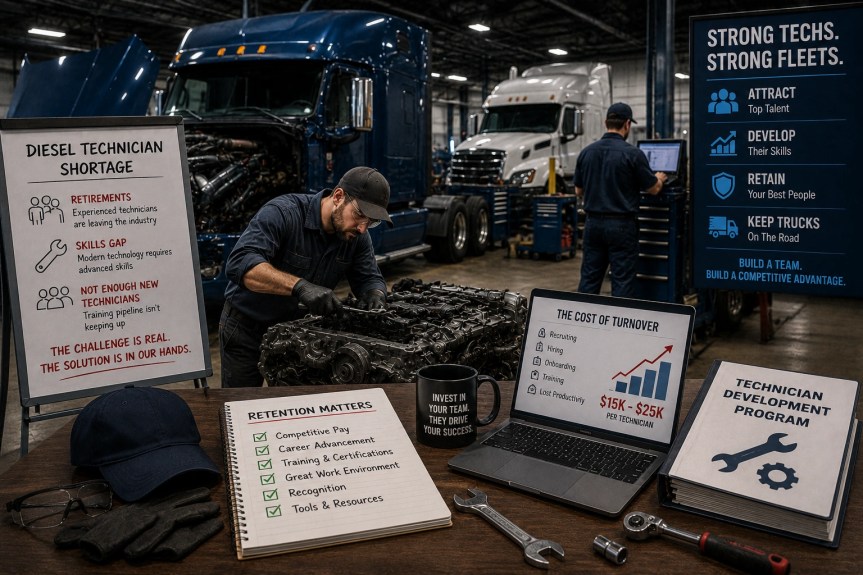
Across the commercial trucking and fleet management industry, one workforce challenge consistently ranks above all others in both severity and business impact: the shortage of qualified diesel technicians. The Bureau of Labor Statistics projects approximately 26,500 annual job openings for diesel service technicians nationwide — openings that the current pipeline of trained candidates cannot fill. The shortage affects 65.5 percent of maintenance shops, and the consequences compound across every dimension of fleet operations.
For fleet operators, this isn’t a distant labor market abstraction. It shows up as extended repair turnaround times, deferred maintenance that accumulates into larger failures, outsourced work at premium rates, and trucks sitting in bays waiting for a technician with the skills to fix them. The fleet operators who build and maintain strong technical workforces gain a meaningful operational advantage over those who cannot. Understanding what drives the shortage — and what actually works to address it — is increasingly a core competency for fleet management.
The Scale of the Problem
The diesel technician shortage has structural roots that predate the current labor market environment and will persist well beyond any cyclical tightening. The commercial trucking industry is experiencing the retirement of a large cohort of experienced senior technicians who entered the trade in the 1980s and 1990s — technicians whose diagnostic knowledge and institutional expertise cannot be quickly replaced regardless of compensation levels.
Simultaneously, the complexity of modern diesel equipment has increased dramatically. A Class 8 truck today is an integrated electronic system with hundreds of sensors, multiple control modules communicating over proprietary data networks, sophisticated aftertreatment systems requiring specialized diagnostic tools, and engine management software that changes with over-the-air updates. The technical competency required to diagnose and repair these vehicles has expanded faster than training programs have adapted, creating a skills gap within the available technician population on top of the raw headcount shortage.
The ATRI found that 44 percent of diesel technicians in trucking have considered transitioning to other mechanical trades — a figure that reflects not just compensation dissatisfaction but broader workplace culture and career development concerns that fleet operators have direct ability to influence.
Why Technicians Leave — and Where They Go
Understanding technician attrition requires looking beyond compensation to the full set of factors that drive career decisions for skilled tradespeople. ATRI research identifies the primary drivers of diesel technician turnover as:
- Compensation below regional market rates, particularly when cost of living has risen faster than pay adjustments
- Limited career advancement pathways, where technicians see no clear progression from their current role and no structured process for building toward senior or specialist positions
- Poor supervisor relationships, including inadequate communication about performance expectations and limited recognition for skill development and quality work
- Insufficient task variety, where technicians are confined to repetitive maintenance work without exposure to the complex diagnostic challenges that develop expertise and maintain engagement
- Inadequate tooling and equipment, where technicians are expected to diagnose modern electronic systems without current diagnostic platforms or software
The destination for departing technicians varies. Some transition to dealer service departments offering structured training programs and manufacturer-backed certification support. Others move to industries with higher compensation — oil and gas, agriculture equipment, or construction equipment — that compete for the same diagnostic skill sets. Some leave the trade entirely for roles with better work-life balance and less physical demand.
Compensation: Necessary But Not Sufficient
Competitive compensation is the prerequisite for technician attraction and retention — but it is not sufficient on its own. The median wage for diesel technicians nationally reached $60,640 in May 2024, with senior certified technicians in high-demand markets earning $70,000 to $90,000 or more. Master technicians at premium employers regularly exceed $100,000 when overtime and incentives are included.
Fleet operators who benchmark compensation against regional market rates — not national medians — and adjust regularly rather than waiting for annual reviews retain more of their technical workforce than those who allow market drift to accumulate. The cost of replacing a journeyman technician — recruiting, hiring, onboarding, and the productivity gap during the 12 to 18 months it takes a new hire to reach full effectiveness — consistently exceeds $15,000 to $25,000 per position. That figure provides context for how much investment in retention is financially justified.
Beyond base pay, compensation structures that reward certification attainment, diagnostic accuracy, and productivity benchmarks create direct financial incentives aligned with the behaviors that make technical teams more effective. Tool allowances, healthcare benefits comparable to competing industries, and schedule flexibility where operationally possible all contribute to total compensation packages that compete with alternatives available to qualified technicians.
Training and Career Development as Retention Strategy
The fleet operators who consistently outperform in technician retention share a characteristic that goes beyond compensation: they invest in structured development programs that give technicians a visible path forward and the organizational support to travel it.
ASE certification support — covering exam fees, providing study time, and linking certification attainment to pay increases — signals to technicians that the organization values their professional growth and is willing to invest in it. Major fleet operators have implemented programs providing 40 or more annual training hours per technician, combining manufacturer-specific online modules, diagnostic platform training, and structured mentorship from senior technicians. These programs reduce attrition significantly by addressing the advancement visibility problem that drives many experienced technicians to seek development opportunities elsewhere.
Structured career ladders — defined progression from apprentice through journeyman, senior technician, and specialist or shop foreman roles, with explicit competency requirements and compensation benchmarks at each level — give technicians a map for their career within your organization. Without that map, talented technicians draw their own conclusions about their advancement prospects, often concluding that the path forward runs through a different employer. A comprehensive framework for building a diesel technician career path that retains top talent covers how leading fleet operators structure these programs from apprentice to master technician level.
Recruiting From Non-Traditional Pipelines
The traditional technician recruitment pipeline — diesel technology programs at community colleges and vocational schools — cannot produce enough qualified graduates to meet current demand. Fleet operators who rely exclusively on this source compete for the same limited pool with every other employer in their market. Expanding the recruitment pipeline requires deliberate effort on multiple fronts.
Community partnerships with technical schools create relationships that give fleet operators preferred access to graduates before they enter the open market. Apprenticeship programs that bring students into paid, structured learning environments while they complete their credentials are among the most effective pipeline development strategies available — and federal and state workforce development funding often partially offsets the cost.
Military veteran outreach represents a consistently underutilized pipeline for diesel technical talent. Veterans with military occupational specialties in vehicle maintenance — 91 series in the Army, 3521 in the Marines, 2T300 in the Air Force — arrive with structured maintenance training, disciplined work habits, and experience on complex mechanical systems. Many transition programs actively place veterans in civilian technical roles, and VA education benefits can offset training costs for both the veteran and the employer.
The women-in-diesel pipeline is growing but remains systematically underutilized by most fleet operators. With 290,000 diesel technician jobs nationwide and job placement rates above 95 percent at quality training programs, female technicians entering the field are highly employable — and organizations that build inclusive workplace cultures and actively recruit from this pipeline access talent that competitors are systematically ignoring.
What Fleet Operators Can Do Right Now
Addressing the diesel technician shortage is not a problem that resolves through a single initiative. It requires sustained investment across compensation benchmarking, development programming, workplace culture, and pipeline building — activities that compound over time rather than producing immediate results.
Fleet operators who take the shortage seriously enough to build a structured response consistently improve their technician retention, reduce their dependence on expensive outsourced repair, and build the internal capability that supports fleet uptime at scale. Those who treat it as an environmental condition outside their control find their maintenance capacity constrained by workforce limitations that are, in fact, addressable.
For fleet managers who want a comprehensive framework for understanding the shortage and implementing evidence-based solutions, the diesel technician shortage guide for fleet managers at Heavy Duty Journal covers the root causes, quantified impacts, and proven strategies that leading operators are using to build and retain technical workforces in the current environment.
The Workforce Advantage Is Real
In an industry where every fleet competes for the same freight on the same lanes with the same trucks, operational advantages are hard to build and easy to lose. A maintenance team that can diagnose accurately, turn vehicles around quickly, and keep uptime above 95 percent is a genuine competitive asset — one that attracts driver talent, supports customer service commitments, and protects the revenue-generating capacity of every truck in the fleet.
Building that team in a shortage market is harder than it was a decade ago. It requires more intentional hiring, more structured development, and more consistent investment in the conditions that make qualified technicians choose to stay. The fleet operators who make that investment are building something their competitors cannot quickly replicate. That is precisely what makes it worth building.
About the Author:- Michael Nielsen is the editor and publisher of Heavy Duty Journal, a free digital trade publication serving diesel technicians, fleet managers, and owner-operators in the commercial trucking industry. He brings 15+ years of hands-on experience in diesel repair and fleet operations to HDJ’s editorial coverage.
 Assets Business Blog