

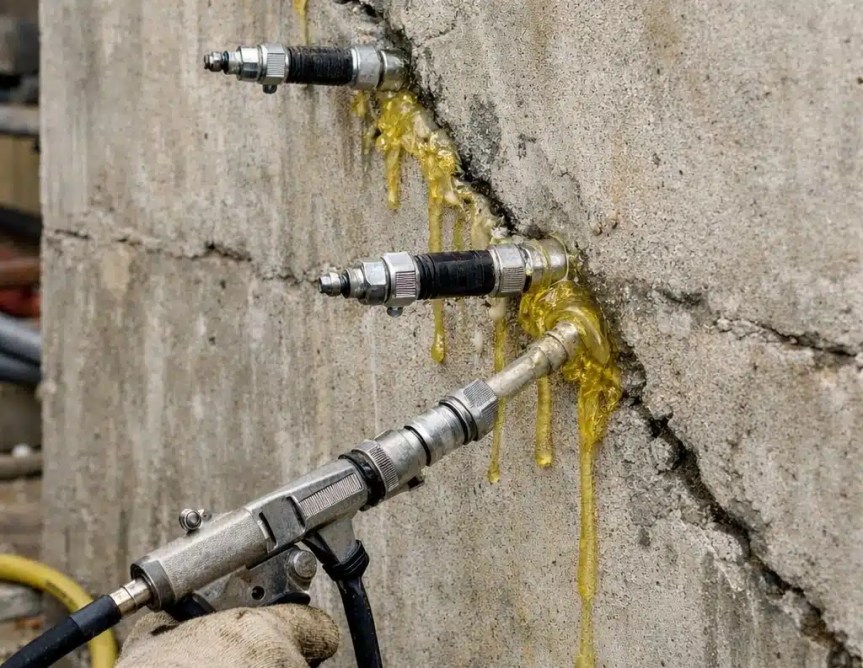
PU injection grouting to seal concrete cracks and water leaks is one of the most versatile and reliable methods available for restoring the integrity of concrete structures that have been compromised by cracking or joint failure. The technique works from the accessible face of the structure, without the need for excavation, membrane removal, or access to the external face of the element being treated. For below-ground structures, underground carparks, water retaining structures, and any concrete element that is leaking and difficult to access externally, PU grouting is often the most practical solution available.
How Polyurethane Grouting Seals Leaks
Polyurethane injection grouting works by introducing a reactive resin into the crack or void through a series of injection ports drilled into the concrete at defined spacing. When the resin contacts moisture within the crack, it undergoes a chemical reaction that causes it to expand and foam, filling the crack geometry and pressing outward against the concrete walls to form a flexible, waterproof seal.
The key properties that make polyurethane resin effective for this application are its reactivity with water, its ability to expand significantly from its initial injected volume, and the flexibility of the cured material. Unlike rigid epoxy resins that bond the crack faces rigidly, cured polyurethane can accommodate minor structural movement without re-opening. This flexibility is important in concrete structures subject to thermal cycling, settlement, or vibration.
For active leaks where water is flowing through the crack at the time of treatment, a fast-reacting resin formulation is selected. The rapid expansion stops the water flow quickly, after which the slower-reacting material that has already penetrated deeper into the crack continues to cure and form a more complete seal.
Applications in Singapore’s Building Stock
PU injection grouting for concrete cracks and leaks is applied across a wide range of structure types in Singapore.
- Underground carparks – the most common application, where construction joints between slabs and walls develop leaks under groundwater pressure over time
- Basement retaining walls – where hydrostatic pressure from surrounding ground forces water through cracks and construction joints in the wall structure
- Lift pits – often the deepest point in a building and therefore subject to the highest groundwater pressure, lift pits are a frequent source of active leakage in older buildings
- Water features and swimming pools – structural cracks in water-retaining elements allow significant water loss and require sealing from the water-side face where external membrane access is not available
- Podium slabs and service ducts – where construction joints above occupied spaces are allowing water to track down to tenant areas below
In each of these applications, the ability to treat from the accessible face without disrupting the structure significantly is the primary advantage over alternative remediation approaches.
The Installation Process in Practice
A PU grouting treatment begins with investigation of the cracked area to map the extent of the defect and confirm the spacing and depth of injection ports required. The ports are drilled perpendicular to the crack face at a depth and spacing calculated to ensure the injected material travels the full length of the crack.
Packers, which are small fittings that seal the port and provide a connection point for the injection equipment, are installed in each port. The injection sequence begins from the lowest or wettest port, working upward or toward drier areas. Injection continues at each port until resin is observed flowing from the adjacent port, confirming that the material has travelled between ports and the full section has been treated.
After curing, the treated area is inspected to confirm that the leak has been sealed. Any ports that have not achieved full penetration are re-treated as needed.
Product Selection: Why It Matters
Not all polyurethane grouting products are the same, and selecting the wrong product for a specific application is one of the most common reasons PU grouting treatments fail to produce lasting results.
Key variables in product selection include:
- Reaction speed: Faster-reacting products are needed for active, flowing leaks. Slower products penetrate fine cracks more effectively
- Expansion ratio: Higher expansion products are appropriate for larger voids. Lower expansion products produce a denser, stronger cure in finer cracks
- Shore hardness of cured material: Softer, more elastic cured products accommodate more structural movement. Harder products provide greater resistance to water pressure
- Chemical resistance: Where the grouting is applied in contact with aggressive groundwater or industrial effluents, chemical compatibility must be confirmed
Proof-Tech’s PU grouting specialists select the appropriate product based on the specific site conditions and the performance requirements of each application.
As former BCA Director of Construction Quality and Safety Er. Ho Siow Ping once noted in industry forums, “The performance of any repair system depends on the accuracy of the diagnosis and the appropriateness of the materials selected for the specific conditions.” PU grouting applied with the wrong product, or without adequate investigation of the crack pattern, will not deliver the results the building owner expects.
When PU Grouting Is the Right Choice
PU injection grouting to seal concrete cracks and water leaks is the right choice when the structure is leaking through discrete cracks or joints, when access to the external face of the structure is restricted or impractical, and when the structural movement characteristics of the element make a flexible seal more appropriate than a rigid one.
For any Singapore building experiencing active water leakage through concrete, a professional assessment by a specialist in PU grouting is the most efficient route to a lasting solution.

